Bean There, Done That: How Chinese Coffee Extracts a New Kind of Belonging
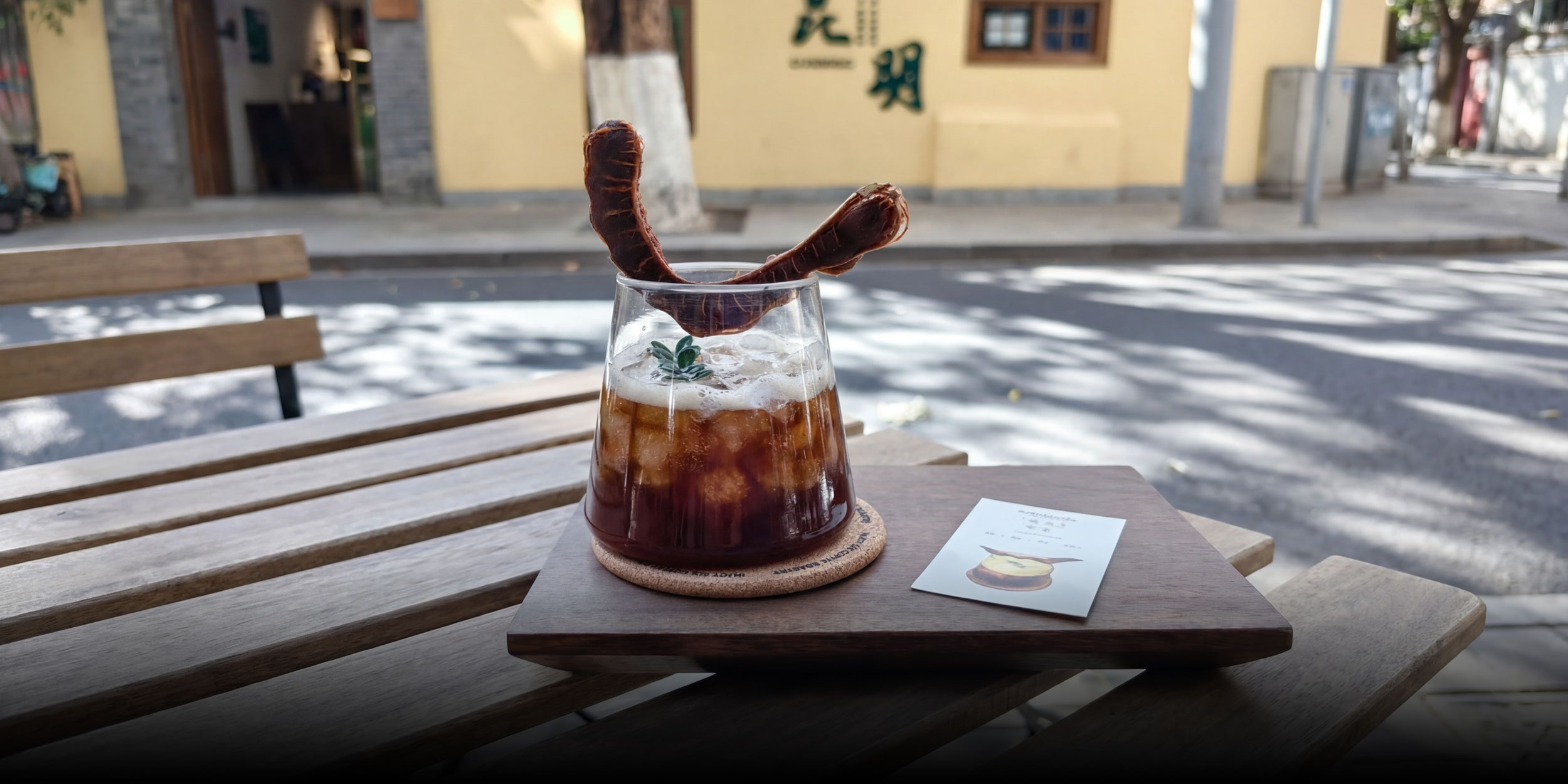
YUNNAN, Southwest China — At a café in Kunming, 23-year-old graduate student Liu Ying drinks a tamarind americano. In her cup, bitter coffee beans from Yunnan’s famed Pu’er region meet the sweet-and-sour tang of dried local tamarind — a combination that shouldn’t work, yet somehow does.
“Tamarind itself is quite dry and sticks to your teeth,” she tells Sixth Tone. “But when combined with an americano, it retains that characteristic taste while being easy to drink.”
Liu is part of a new generation of Chinese coffee drinkers who want more than just caffeine; they’re seeking cultural connection in a cup, and a growing number of cafés across the country are racing to provide it.
From tofu pudding to truffles, porcini mushrooms to vegetable stalks, and even fermented mung bean juice, independent cafés from Beijing to Kunming are experimenting with local ingredients once unthinkable in coffee. And as outlets multiply across China’s $43-billion coffee industry — which includes international giants like Starbucks and homegrown chains such as Luckin and Manner — standing out increasingly means brewing drinks rooted in local flavors.
For Liu, these experiments are a way of seeing herself in what she drinks. “When I try these fusions, it’s not just about tasting regional ingredients with coffee,” she says. “It’s about experiencing the fusion of local food culture with coffee culture.”
Some pairings have surprised her: she’s seen coffees mixed with sweet soy sauce and even chilies. “I have a high tolerance level,” she says. “But I haven’t dared try those. I’m interested, but a bit scared of ‘picking a bad one.’”
She’s more drawn to familiar local flavors like rose or fermented rice sugar. As a Yunnan native, Liu feels these drinks connect her more deeply to home. “Through a single drink, I learn about local food culture, customs, and even history. It makes me feel proud of where I’m from.”
Experimenting with flavors
It’s a demand that local cafés like Injoy Six Coffee are increasingly working to meet. For Zhang Sixi, the independent café’s brand director, turning ingredients native to Yunnan, such as tamarind and Litsea cubeba — a floral evergreen with a citrusy, aromatic oil — into drinks that resonate with customers is both a creative challenge and a strategic mission.
The shop’s concept of “coffee with Yunnan specialties” gradually grew out of the team’s deep roots in Pu’er. Spending much of their time at local estates alongside coffee farmers, they developed a sensitivity to regional ingredients. The idea for a Yunnan-style americano — tamarind’s sweet-tart bite meeting coffee’s acidity — emerged from that immersion. “We aim to put Yunnan’s natural environment into a coffee cup,” Zhang says.
The biggest challenge was balancing flavors. Regional ingredients like Litsea cubeba, commonly known as mountain pepper in the West, have such sharp fragrances that they risk overpowering the coffee.
“We spent nearly a month debugging,” Zhang says. They finally found a flavor balance by lightly roasting Yunnan beans to bring out their citrusy acidity, slow brewing at low temperatures, and adding a touch of wild honey to soften the edge. “Coffee as the base, specialty as the accent,” he says.
Their localized brews target three groups: tourists seeking an experience unique to Yunnan, local youth with cultural ties to hometown flavors, and coffee enthusiasts chasing niche fusions.
In the broader trend, Zhang sees coffee with local characteristics as inevitable in China’s evolution of coffee culture. “Consumers seek drinks with warmth and cultural belonging, while brands need uniqueness through differentiated expression,” he says.
Hsieh Pei Yun, owner of a Beijing coffee shop tucked near the Temple of Heaven, takes a more measured approach to the localized coffee trend. She considers the market to be fueled predominantly by consumers’ novelty seeking, where “checking in” on social media takes precedence over interest in the coffee itself. In her view, the best-tasting coffee remains a pure americano, and everything else is gilding the lily.
Her shop, open for four years, sits in the heart of douzhi culture — a pungent fermented mung bean juice commonly found in the capital’s traditional breakfast shops. That inspired her “douzhir dirty,” blending Beijing’s iconic drink with a dirty — a popular Asian coffee in which an espresso is poured directly onto chilled milk, gradually trickling down to create a muddied appearance — to create something firmly rooted in the city’s storied hutong, or ancient alleyways.
Hsieh doesn’t position the drink as a traffic driver or signature item. In fact, she’s cautious about its growth. “If we sold a lot more, I wouldn’t necessarily be happier,” she says, “because it might just mean people are coming for the novelty.”
She adds that she’s not chasing mass appeal and finds negative reviews understandable, as douzhi is deeply polarizing. “The drink is an expression of the area’s character, not a marketing tool designed to please the crowd,” she says.
Curious customers
But not all localized coffees start with a neighborhood. Some begin with a customer.
A few hundred miles south in Wuhan, capital of the central Hubei province, that’s what happened to café owner Wang Lei. Two years ago, a regular customer brought him caitai, the flowering stalk of the purple rape plant popular in the region, and suggested pairing it with coffee. Having already tried bitter melon, celery, cilantro, ginger, and pine nut coffee variations, Wang welcomed the challenge.
The main technical difficulty lies in the ingredient’s sensitivity to temperature: caitai turns bitter in warm conditions and only sweetens after frost. To stabilize the flavor, Wang developed his own process, chilling the caitai post-harvest, juicing it while cold, and applying a special treatment to ensure consistency. The result was his “caitai coffee.”
As for market acceptance, Wang stays detached, saying he doesn’t lose sleep over any single product’s popularity. His invention isn’t even officially on the menu; it’s promoted quietly in store to curious customers.
“I use ingredients grown locally in Wuhan specifically to remind people: when you buy and taste these foods in markets, don’t forget the labor, skill, soil, and temperatures that go into them,” Wang says. “Most importantly, don’t forget the time that goes into their cultivation and production.”
While Wang sees local ingredients as a way to reconnect people with the land, café owner Zeng Jingwei, also in Wuhan, takes a slightly different tack: the popular appeal of a given ingredient.
Zeng points to examples like douzhi or caitai coffee: if the ingredient itself isn’t widely loved, the barrier to acceptance is high. Ingredients with broader appeal, like black sesame or tamarind, integrate far more easily, he says.
That philosophy inspired him to create a black sesame dirty at his shop, Toto Coffee, last year. “Beyond flavor, I also wanted the drink to tap into shared emotional memories, like the childhood nostalgia many have with black sesame paste,” he says.
Zeng says his future creations might not carry traditional Wuhan flavors. Instead, he remains keen on innovation driven by the inherent appeal of the ingredients themselves, citing Luckin Coffee’s use of Moutai, the renowned Chinese baijiu liquor brand, in its coffee.
Wang, by contrast, says he’ll keep experimenting with local ingredients, grounded in localization and connection to the land.
“Enjoying the development process itself, and communicating with those who truly appreciate the product, is more meaningful than pursuing broad commercial success,” he says.
Additional reporting: Sun Rong; editor: Marianne Gunnarsson.
(Header image: The tamarind cold brew at Injoy Six Coffee in Kunming, Yunnan province, January 2026. Fan Yiying/Sixth Tone)